

Instagram SEO for travel brands: the MaxTour playbook
20 Aug 2026
Most travel brands still treat search as a Google problem. Their customers have quietly moved.
Skift reports that 83% of travellers use social media before they book. A large share of those journeys don't begin with a browse — they begin in a search box, inside Instagram or TikTok.
That makes social search a distribution channel. And like any distribution channel, you can either show up in it deliberately or hope you get lucky.
What showing up actually looks like
MaxTour, a tour operator running trips out of Las Vegas, is a useful example — because you can check the result yourself.
Search "Grand Canyon from Vegas" on Instagram. MaxTour appears twice in the first five results.
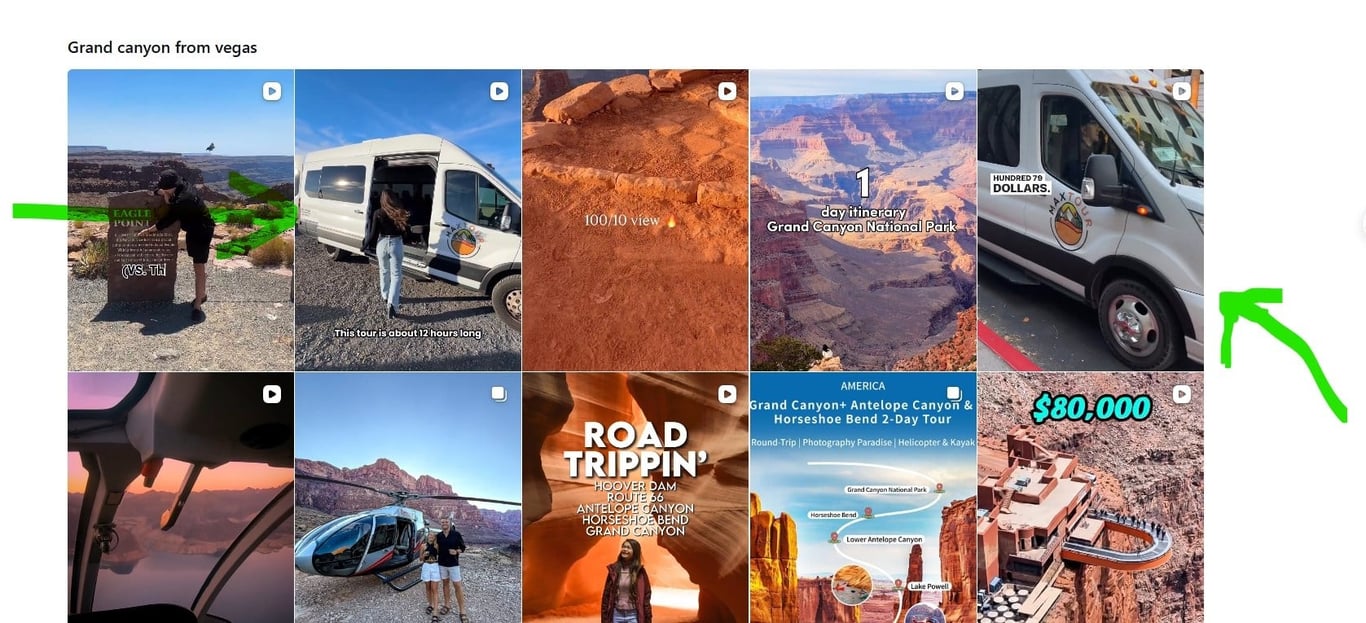
The top of Instagram's results for "Grand canyon from vegas". The arrows mark MaxTour — two placements in the first five.
That is not a vanity metric. Nobody is impressed by it at a dinner party. But it sits directly in front of a person with obvious commercial intent, at the exact moment they are deciding who to book with. That is distribution.
MaxTour also takes more than 80% of its bookings direct. The two facts are related, and the relationship is not an accident.
The mechanism: volume, not a lucky pick
Here is the part most brands get wrong.
MaxTour has creators out on tour nearly every day. They pay a bonus when a post crosses a view threshold. The content is consistent, high in volume, and built around the same handful of search terms.
Crucially, they are not trying to identify the one creator who will land them at the top of the results. Nobody can reliably pick that creator, because nobody controls the algorithm — not the brand, and not the creator either.
So the strategy isn't selection. It's shots on goal. Post enough relevant, well-constructed content around a term and some of it surfaces. That is a fundamentally different operating model from hiring one large account and hoping.
The unglamorous bit that makes it measurable
MaxTour added one piece of friction to their booking flow:
Customers cannot check out without answering where they heard about the business.
It is a small thing and it changes everything. Without it, creator marketing is a cost line with a vibe attached. With it, you know which channel produced the booking — which means you know what to do more of.
If you do not know where your bookings come from, you are guessing. Guessing is an expensive marketing strategy.
What to take from this
Not "copy MaxTour". Your product, margins, location and customer behaviour are different, and a Grand Canyon day tour is not a five-night resort stay.
Take the sequence instead:
- Pick the outcome first. Social search visibility is one strategy. Getting authentic content you can use in your own ads is another. Building awareness with a creator's audience is a third. Using promo codes and affiliate links to identify who actually drives sales is a fourth. Each needs different creators, different briefs, and a different definition of success.
- Then pick creators against it — not the other way round.
- Then make it measurable, before the first creator arrives.
Creator marketing has underperformed in travel for years, and this is most of the reason. "We hosted someone and they posted a Reel, now what?" is not a strategy. The good news is that most of your competitors are still doing exactly that — or not working with creators at all.
How to actually do it
If social search visibility is your goal, start here.
Write down the 3–5 search terms you want to show up for. Be specific and commercial. "Grand Canyon from Vegas" is a search term. "Amazing desert vibes" is not. If you wouldn't type it into a search box while holding a credit card, it doesn't belong on the list.
Then tell creators where to put those words. Placement is what makes content findable:
- In the first 3 seconds of the reel, spoken out loud
- On screen, as a text overlay
- In the first portion of the caption
That is the whole brief. Note what it does not do: it doesn't dictate style, format, edit or personality. Creators are better at that than you are, and content that looks like an ad performs like an ad. You are only specifying where the important words go.
Then check the results yourself. Search your own terms once a month and see who shows up. It takes five minutes, and for this particular goal it is the only scoreboard that matters.
Frequently asked questions
How many creators do I need?
More than one. This is a volume strategy — the entire point is that you cannot predict which post will surface, so a single collaboration is a lottery ticket. Pick a number you can sustain every month rather than one large one-off.
Does this work on TikTok as well as Instagram?
Yes, and the mechanics are close enough that one brief covers both. TikTok's search behaviour is, if anything, more established.
Won't specifying keywords make the content feel fake?
Only if you script the content. There is a real difference between "say this sentence" and "make sure these three words appear in the first line of your caption". The second is invisible to the viewer.
How long does it take to work?
Longer than one campaign. Search results reflect accumulated content, so this compounds — which is also why it is defensible once you are there.
Where to start
Pick your 3–5 terms this week. That one exercise usually reveals whether a brand has a creator strategy or just a creator budget.
If you want to see which creators are already making content in your destination and category, browse the map. And if you are a hotel, tour operator, DMO or airline looking to run this properly, here is how CollabsMap works for brands.